(Last updated February 2026)
Figure . The molecular diagram of [amino-[(Z)-2-carboxyvinyl]sulfanyl-methylene]ammonium chloride monohydrate.
| REFCODE | XAFQON |
|---|---|
| Formula | C4 H7 N2 O2 S1+ . Cl- . H2 O |
| Common Name | |
| IUPAC Systematic Name | [amino-[(Z)-2-carboxyvinyl]sulfanyl-methylene]ammonium chloride monohydrate |
| Other Names | Blind Test XXIV |
| CSD Refcodes | XAFQON |
| Search Identifier | A |
| Scientist | Rui Guo |
| Date | 2015 |
| Publication | Reilly, AM et al, Acta Cryst. B, (2016) 72, 439-459 DOI: Open paper (10.1107/S2052520616007447) |
| Energy model | 7 (published List 2) |
| Study_ID | 33 |
| Programs | Study_ID=12, DMACRYS (2.0.8) |
| Location on S Drive | \\CHEMISTRY_CPOSS\\BlindTest2015\\XAFQON\\PCM11_Will |
| Potential Description | GDMA2.2(PCMdielectric11(PBE1PBE/6-31G(d,p))) + Will + Day chloride ion + Halgren sulfur potential |
| Intramolecular Description | PBE1PBE/6-31G(d,p) |
| Energy model | 2 (published List 1) |
| Study_ID | 10 |
| Programs | Study_ID=11, CrystalOptimizer, DMACRYS (2.0.8) |
| Location on S Drive | \\CHEMISTRY_CPOSS\\BlindTest2015\\XAFQON\\CrystOpt_FIT_chloride |
| Potential Description | CrystalOptimizer with GDMA2.2(PBE1PBE/6-31G(d,p)) + FIT + Day chloride ion potential |
| Intramolecular Description | PBE1PBE/6-31G(d,p) |
| Energy model | 6 |
| Study_ID | 30 |
| Programs | Study_ID=10, DMACRYS (2.0.8) |
| Location on S Drive | \\CHEMISTRY_CPOSS\\BlindTest2015\\XAFQON\\PCM11_FIT_chloride |
| Potential Description | GDMA2.2(PCMdielectric11(PBE1PBE/6-31G(d,p))) + FIT + Day chloride potential |
| Intramolecular Description | PBE1PBE/6-31G(d,p) |
| Energy model | 5 |
| Study_ID | 32 |
| Programs | Study_ID=11, DMACRYS (2.0.8) |
| Location on S Drive | \\CHEMISTRY_CPOSS\\BlindTest2015\\XAFQON\\PCM11_FIT |
| Potential Description | GDMA2.2(PCMdielectric11(PBE1PBE/6-31G(d,p))) + FIT |
| Intramolecular Description | PBE1PBE/6-31G(d,p) |
| Energy model | 4 |
| Study_ID | 31 |
| Programs | Study_ID=11, DMACRYS (2.0.8) |
| Location on S Drive | \\CHEMISTRY_CPOSS\\BlindTest2015\\XAFQON\\PCM3_FIT |
| Potential Description | GDMA2.2(PCMdielectric3(PBE1PBE/6-31G(d,p))) + FIT |
| Intramolecular Description | PBE1PBE/6-31G(d,p) |
| Energy model | 3 |
| Study_ID | 12 |
| Programs | Study_ID=11, CrystalOptimizer, DMACRYS (2.0.8) |
| Location on S Drive | \\CHEMISTRY_CPOSS\\BlindTest2015\\XAFQON\\CrystOpt_Will |
| Potential Description | CrystalOptimizer with GDMA2.2(PBE1PBE/6-31G(d,p)) + Will + Day chloride ion + Halgren sulfur potential |
| Intramolecular Description | PBE1PBE/6-31G(d,p) |
| Energy model | 1 |
| Study_ID | 11 |
| Programs | Flexible CrystalPredictor (1.8), CrystalOptimizer, DMACRYS (2.0.8) |
| Location on S Drive | \\CHEMISTRY_CPOSS\\BlindTest2015\\XAFQON\\CrystOpt_FIT |
| Potential Description | CrystalOptimizer with GDMA2.2(PBE1PBE/6-31G(d,p)) + FIT |
| Intramolecular Description | PBE1PBE/6-31G(d,p) |
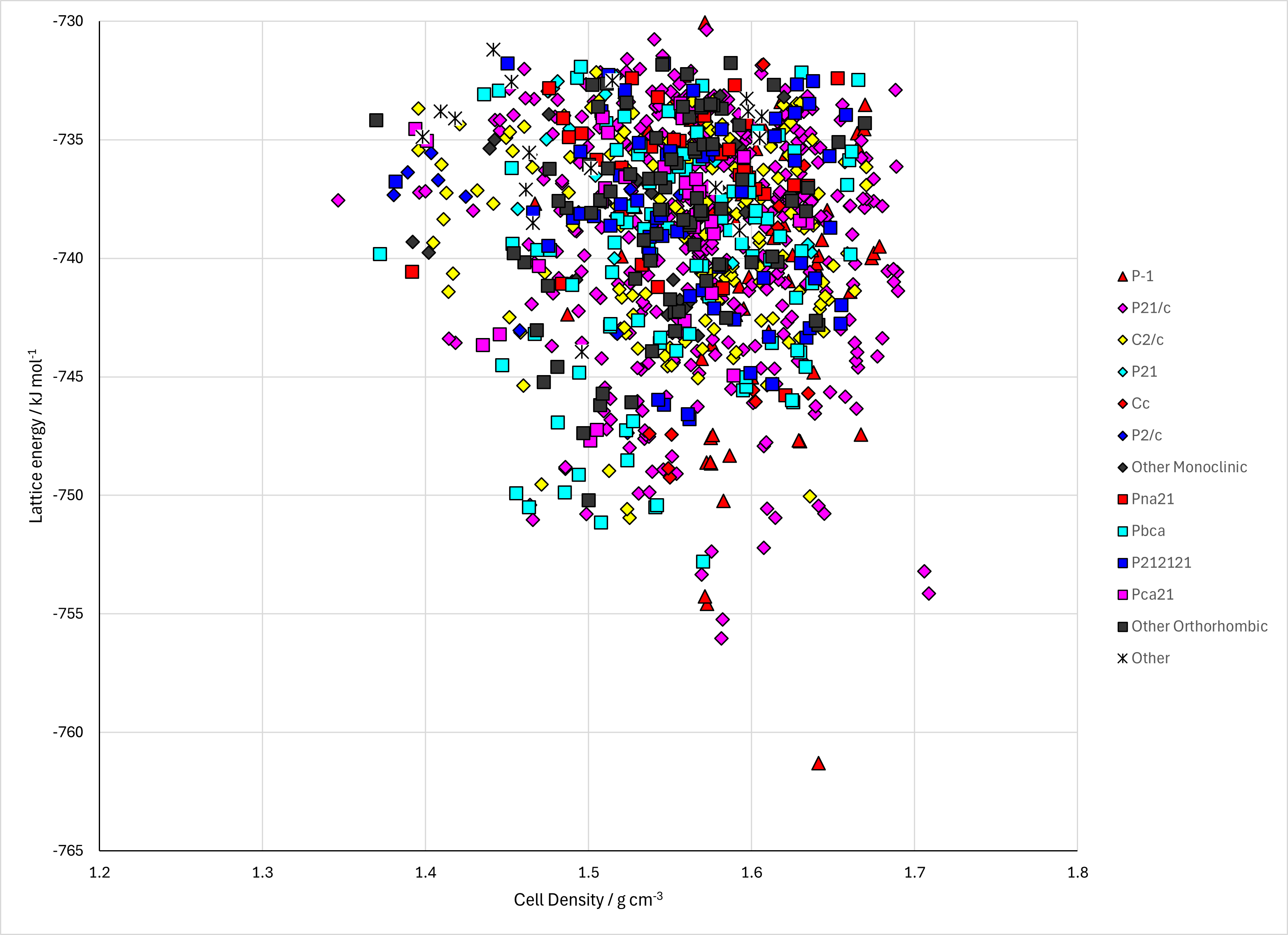
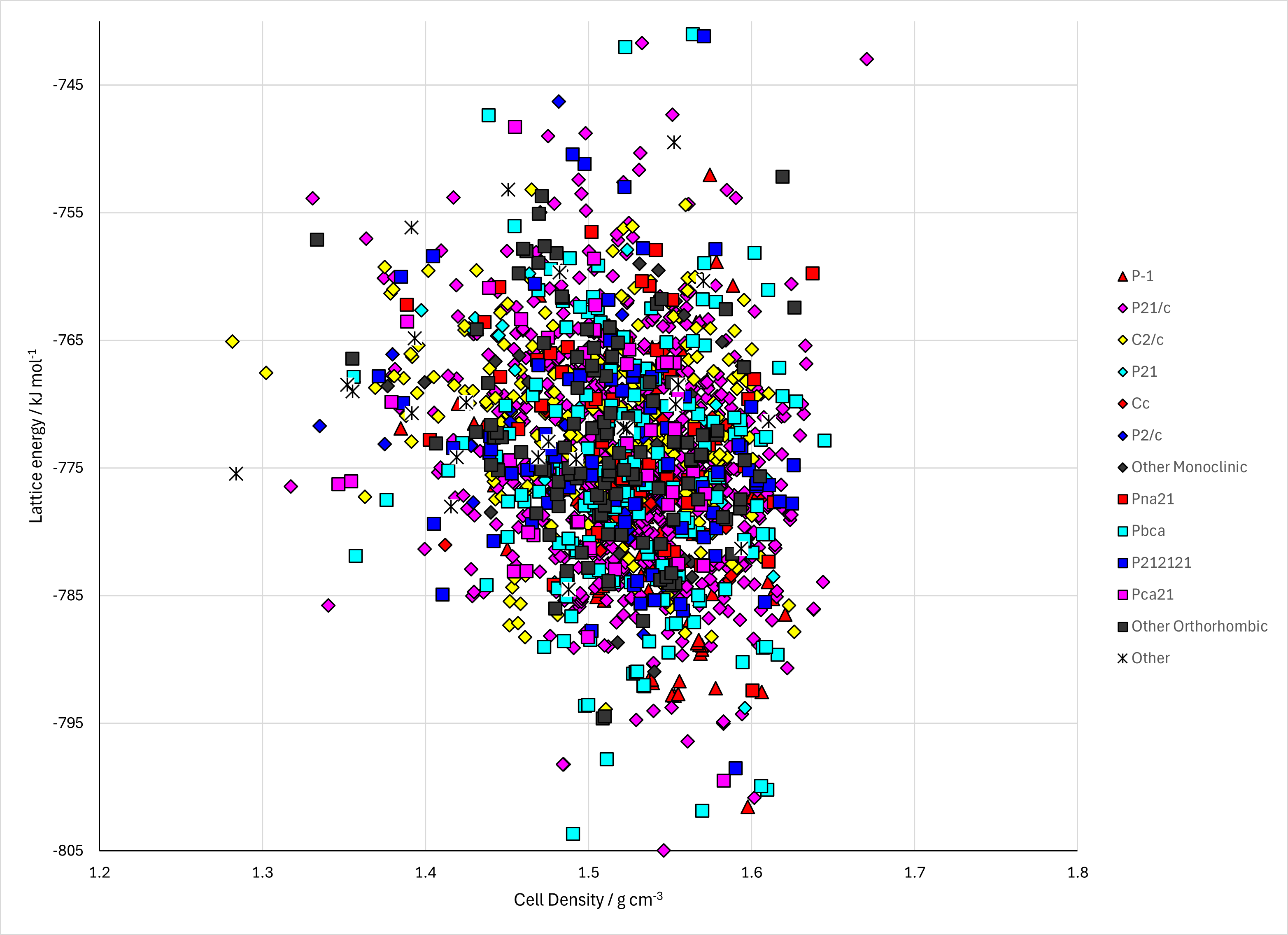
Figure . Crystal energy landscape of [amino-[(Z)-2-carboxyvinyl]sulfanyl-methylene]ammonium chloride monohydrate from previous work. Left: CrystOpt with FIT potential and Day chloride ion (Energy Model 2). Right: Single point PCM model with Williams potential (Energy Model 7).
Table . Crystallographic information for CSD entries for [amino-[(Z)-2-carboxyvinyl]sulfanyl-methylene]ammonium chloride monohydrate. Different polymorphs are coloured differently.
| REFCODE | space group | Z’ | a / Å | b / Å | c / Å | α / ° | β / ° | γ / ° | density / g cm-3 | Form |
|---|---|---|---|---|---|---|---|---|---|---|
| XAFQON | P21/c | 1.0 | 3.9906 | 21.2366 | 10.1014 | 90.0 | 97.8331 | 90.0 | 1.5714 | None |
Table . Experimental information for CSD entries for [amino-[(Z)-2-carboxyvinyl]sulfanyl-methylene]ammonium chloride monohydrate.
| REFCODE | space group | R factor | T / K | Year | Comments |
|---|---|---|---|---|---|
| XAFQON | P21/c | 2.45 | 240 K | 2016 | Private Communication |
Make this table include whether polymorphs are solution-grown, sublimation grown, templated or otherwise. Add references.
The SI of the paper on the sixth Blind Test makes mention of Regions A, B and C. However, the structure names for the submitted structures don’t agree with these names. Structures without a prefix correspond the Region A. Those with the prefix “i” correspond to Region B (with an intramolecular bond), but virtually all transformed conformation to Region A. Structures with the prefix “C” correspond to Region C, but Region C is like Region B and the main torsion angle transformed to be like Region A but the alternative COOH configuration was unchanged.