(Last updated 1 March 2023)
Figure . The molecular diagram of Flufenamic Acid.
| REFCODE | FPAMCA |
|---|---|
| Formula | C14 H10 F3 N1 O2 |
| Common Name | Flufenamic Acid |
| IUPAC Systematic Name | 2-[3-(trifluoromethyl)anilino]benzoic acid |
| CSD Refcodes | FPAMCA18, FPAMCA17, FPAMCA19, FPAMCA15, FPAMCA16, FPAMCA14, FPAMCA20, FPAMCA13 |
| Search Identifier | A |
| Scientist | Dave Case |
| Date | 2018 |
| Publication | Case, D. H.; Srirambhatla, V. K.; Guo, R.; Watson, R. E.; Price, L. S.; Polyzois, H.; Cockcroft, J. K.; Florence, A. J.; Tocher, D. A.; Price, S. L., Successful Computationally Directed Templating of Metastable Pharmaceutical Polymorphs. Crystal Growth & Design 2018, 18, (9), 5322-5331. DOI: Open paper (10.1021/acs.cgd.8b00765) |
| Energy Model | 1 |
| Study_ID | 10 |
| Programs | Flexible CrystalPredictor (1.8), CrystalOptimizer (2.4.5), DMACRYS (2.2.1.0) |
| Location on S Drive | /CHEMISTRY_CPOSS/Fenamates/FlufenamicAcid/FPAMCA_CO |
| Potential Description | CrystalOptimizer with GDMA2.2(PBE1PBE/6-31+G(d)) + FIT |
| Energy Model | 2 |
| Study_ID | 30 (published) |
| Programs | Study_ID=10, DMACRYS (2.2.0.1) |
| Location on S Drive | /CHEMISTRY_CPOSS/Fenamates/FlufenamicAcid/FPAMCA_PCM |
| Potential Description | GDMA2.2(PCMdielectric3(PBE1PBE/6-31+G(d))) + FIT |
| Scientist | Louise Price |
| Date | 2024 |
| Publication | Database updating paper |
| Energy Model | 3 |
| Study_ID | 11 (includes pDFT-D) |
| Programs | Study_ID=10, CrystalOptimizer (2.4.7), DMACRYS (2.3.1.1) |
| Location on S Drive | /CHEMISTRY_CPOSS/Fenamates/FlufenamicAcid/FPAMCA_DFT |
| Potential Description | CrystalOptimizer with GDMA2.2(PBE1PBE/6-31+G(d)) + FIT |
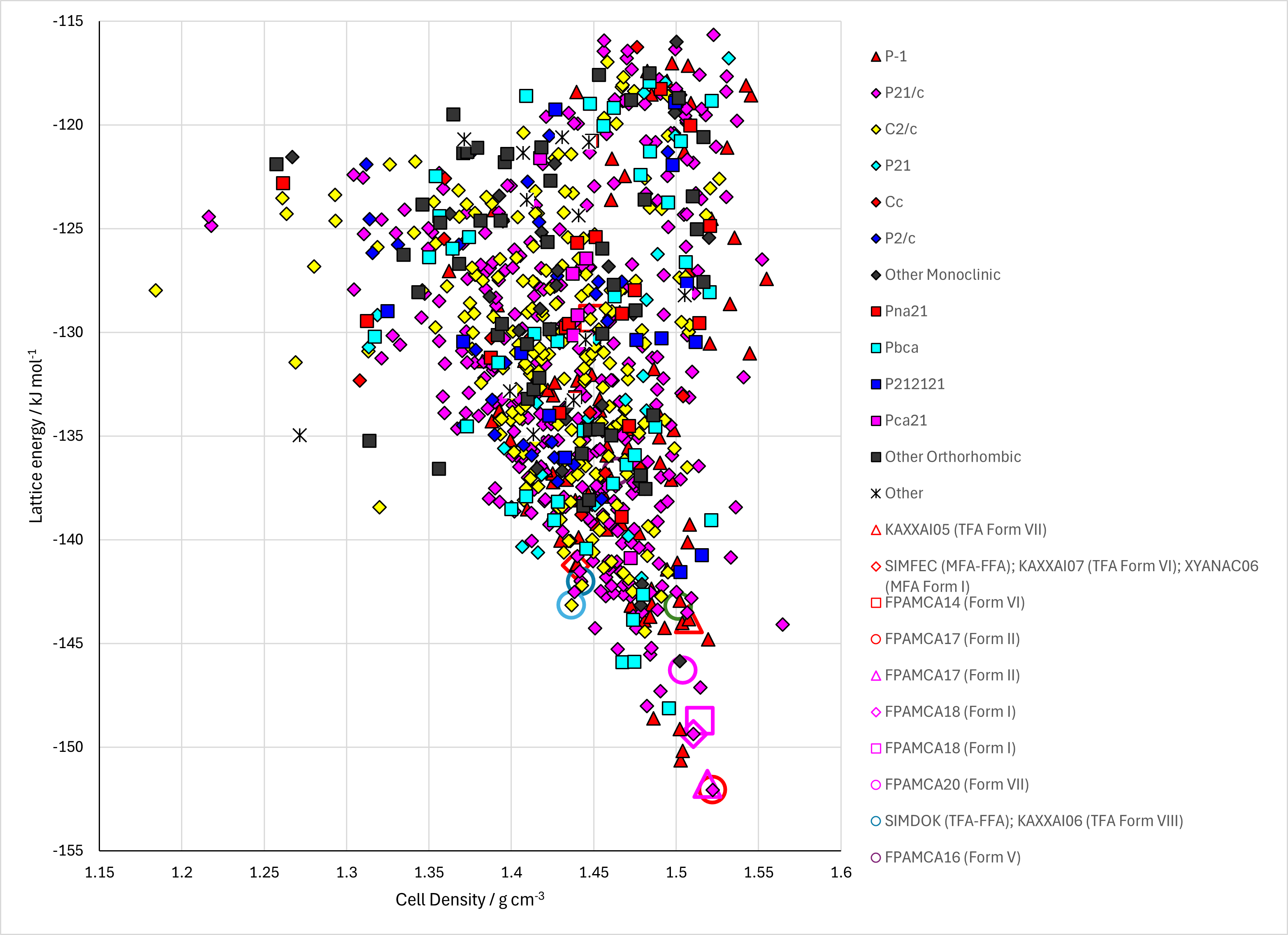
Figure . Crystal energy landscape of Flufenamic Acid from (top left) CrystalOptimizer refinement, (top right) PCM refinement, (bottom left) reoptimization with CrystalOptimizer and (bottom right) comparisons across the different energy models.
Table . Crystallographic information for CSD entries for Flufenamic Acid. Different polymorphs are coloured differently.
| REFCODE | space group | Z’ | a / Å | b / Å | c / Å | α / ° | β / ° | γ / ° | density / g cm-3 | Form |
|---|---|---|---|---|---|---|---|---|---|---|
| FPAMCA | C2/c | 1 | 39.848 | 5.107 | 12.24 | 90 | 92.47 | 90 | 1.501 | III |
| FPAMCA01 | P21/c | 1 | 12.53 | 7.86 | 12.87 | 90 | 95.1 | 90 | 1.48 | I |
| FPAMCA02 | P*/a | 0 | 12.87 | 7.85 | 12.52 | 90 | 95.5 | 90 | 1.484 | I |
| FPAMCA03 | P*/a | 0 | 11.85 | 10.425 | 11.22 | 90 | 112.83 | 90 | 1.462 | II |
| FPAMCA04 | C*/c | 0 | 39.76 | 5.104 | 12.24 | 90 | 92.5 | 90 | 1.505 | III |
| FPAMCA11 | P21/c | 1 | 12.523 | 7.868 | 12.874 | 90 | 95.2 | 90 | 1.479 | I |
| FPAMCA12 | P21/c | 2 | 14.9687 | 20.641 | 7.9486 | 90 | 98.316 | 90 | 1.537 | VII |
| FPAMCA13 | P-1 | 9.5 | 17.0047 | 17.887 | 19.1941 | 81.321 | 89.58 | 78.56 | 1.569 | VIII |
| FPAMCA14 | P-1 | 6 | 8.6485 | 11.5115 | 38.895 | 87.914 | 85.91 | 72.26 | 1.524 | VI |
| FPAMCA15 | P-1 | 3 | 8.7589 | 11.6629 | 20.0229 | 80.632 | 81.041 | 73.532 | 1.458 | IV |
| FPAMCA16 | P21/c | 4 | 26.6592 | 7.9007 | 23.243 | 90 | 94.084 | 90 | 1.53 | V |
| FPAMCA17 | P21/c | 1 | 10.8813 | 10.2374 | 11.7487 | 90 | 111.318 | 90 | 1.532 | II |
| FPAMCA18 | P21/c | 1 | 12.4157 | 7.7528 | 12.6469 | 90 | 94.688 | 90 | 1.54 | I |
| FPAMCA19 | C2/c | 1 | 39.683 | 5.0556 | 11.963 | 90 | 91.91 | 90 | 1.557 | III |
| FPAMCA20 | P21/c | 2 | 15.004 | 20.749 | 7.965 | 90 | 98.31 | 90 | 1.523 | VII |
| FPAMCA21 | C2/c | 1 | 39.6616 | 5.0561 | 11.9613 | 90 | 91.962 | 90 | 1.558 | III |
| FPAMCA22 | C2/c | 1 | 39.6836 | 5.055 | 11.9667 | 90 | 91.939 | 90 | 1.557 | III |
Table . Experimental information for CSD entries for Flufenamic Acid.
| REFCODE | space group | R factor | T / K | Year | Comments |
|---|---|---|---|---|---|
| FPAMCA | C2/c | 4.9 | RT | 1973 | Cryst.Struct.Commun. 2 459 (1973) |
| FPAMCA01 | P21/c | 11 | RT | 1978 | Acta Cryst A. 34 S80 (1978) |
| FPAMCA02 | P*/a | 0 | RT | 1977 | Microscope 25 31 (1977) |
| FPAMCA03 | P*/a | 0 | RT | 1977 | Microscope 25 31 (1977) |
| FPAMCA04 | C*/c | 0 | RT | 1977 | Microscope 25 31 (1977) |
| FPAMCA11 | P21/c | 7.4 | RT | 1982 | Slow evaporation of a solution of 95% ethanol.1 |
| FPAMCA12 | P21/c | 10.11 | 85 | 2012 | Grown from ethanol solution using polymers as heteronuclei.2 |
| FPAMCA13 | P-1 | 19.67 | 85 | 2012 | Grown from ethanol solution using polymers as heteronuclei.2 One additional independent flufenamic acid molecule was severely disordered and the disordered density was taken into account using the SQUEEZE/PLATON procedure. The unit cell was found to contain a void of 271 A3 holding 126 electrons. |
| FPAMCA14 | P-1 | 16.13 | 85 | 2012 | Low temperature (-130 °C) transformation from form IV, by submerging a vial in liquid nitrogen for 10-15 minutes.2 |
| FPAMCA15 | P-1 | 5.42 | 273 | 2012 | Grown from ethanol solution using polymers as heteronuclei.2 F1,F2,F3 and F1A,F2A,F3A disordered over two sites with occupancies 0.508:0.492; F4,F5,F6 and F4A,F5A,F6A disordered over two sites with occupancies 0.67:0.33; F7,F8,F9 and F7A,F8A,F9A disordered over two sites with occupancies 0.618:0.382. |
| FPAMCA16 | P21/c | 7.27 | 95 | 2012 | Grown from ethanol solution using polymers as heteronuclei.2 |
| FPAMCA17 | P21/c | 7.36 | 95 | 2012 | Grown from ethanol solution using polymers as heteronuclei.2 |
| FPAMCA18 | P21/c | 3.74 | 90 | 2014 | Recrystallization from mixed xylenes above 130 °C.3 |
| FPAMCA19 | C2/c | 3.59 | 90 | 2014 | Recrystallization from methanol at room temperature.3 |
| FPAMCA20 | P21/c | 6.14 | 100 | 2020 | Encapsulated nanodroplet crystallization. 200 nL PDMSO, 50 nL of 50 mg/mL flufenamic acid in DMF, 50 nL H2O.4 Synchrotron data |
| FPAMCA21 | C2/c | 3.75 | 106 | 2022 | Slow evaporation from methanol or toluene under ambient conditions.5 A plastic and bendable crystal. |
| FPAMCA22 | C2/c | 11.64 | 106 | 2022 | Slow evaporation from methanol or toluene under ambient conditions.5 A plastic and bendable crystal. |
There is also a Form IX, but this doesn’t have full structural characterization yet.2
FPAMCA18 (Form I, Z’=1)=A560 (RMSD25=0.205 Å), E1 (RMSD25=0.283 Å)
FPAMCA17 (Form II, Z’=1)=A748 (RMSD25 = 0.124 Å), E2 (RMSD25=0.142 Å)
\nFPAMCA17~A826 (11/25)
FPAMCA19 (Form III, Z’=1)=E3 (RMSD25=0.161 Å)
\nFPAMCA19~A1094 (20/25); A928 (20/25); A1767 (18/25); A1098 (12/25); A1508 (10/25); A1511 (10/25); A354 (9/25)
\nA1098 is the same sheet. A1094 and A1767 are double sheets on the hydrogen bonding side and A928 is a double sheet on the opposite side.
FPAMCA15 (Form IV, Z’=3)=E6 (RMSD25=0.391 Å)
\nFPAMCA15~E4 (17/25)
FPAMCA16 (Form V, Z’=4)=E5 (RMSD25=0.378 Å)
\nFPAMCA16~A799 (11/25); 833 (11/25); A1439 (10/25);
FPAMCA14 (Form VI, Z’=6)=E6 (RMSD25=0.38 Å)
\nFPAMCA14~E4 (21/25)
FPAMCA20 (Form VII, Z’=2)=E7 (RMSD25=0.235 Å)
FPAMCA13 (Form VIII, Z’=9.5)~A1782 (11/25)
| (a) (Form I from search) | (b) (Form I experimental minimized) |
|---|---|
| (c) (Form II from search) | (d) (Form II experimental minimized) |
| (e) (Form III experimental minimized) | (f) (Form IV overlaid with experimental Form VI minimized) |
| (g) (Form V experimental minimized) | (h) (Form VI experimental minimized) |
| (i) (Form VII experimental minimized) |
Figure . Overlays of (a) FPAMCA18 (by element) with A560 (green) (RMSD25=0.205 Å), (b) FPAMCA18 (by element) with E1 (green) (RMSD25=0.283 Å), (c) FPAMCA17 (by element) with A748 (green) (RMSD25=0.124 Å), (d) FPAMCA17 (by element) with E2 (green) (RMSD25=0.142 Å), (e) FPAMCA19 (by element) with E3 (green) (RMSD25=0.161 Å), (f) FPAMCA15 (by element) with E6 (green) (RMSD25=0.391 Å), (g) FPAMCA16 (by element) with E5 (green) (RMSD25=0.378 Å), (h) FPAMCA14 (by element) with E6 (green) (RMSD25=0.380 Å), (i) FPAMCA20 (by element) with E7 (green) (RMSD25=0.235 Å),
| ffa1129 | An optimization | |||
|---|---|---|---|---|
| D02 | A single point energy | |||
| MBDstar | A single point energy | |||
| ffa1173 | An optimization | |||
| ffa1248 | An optimization | |||
| D02 | A single point energy | |||
| MBDstar | A single point energy | |||
| ffa1956 | An optimization | |||
| MBDstar | A single point energy | |||
| wrong | Not sure, but some optimizations | |||
| ffa882 | An optimization | |||
| D02 | A single point energy | |||
| MBDstar | A single point energy | |||
| ffa_kaxxai | An optimization | |||
| D02 | A single point energy | |||
| MBDstar | A single point energy | |||
| ffa_kaxxai01 | An optimization | |||
| D02 | A single point energy | |||
| MBDstar | A single point energy | |||
| ffax (ffa_f3) | An optimization | |||
| D02sp | A single point energy | |||
| MBDsp | A single point energy | |||
| fpamca (this is also called f3) | An optimization | |||
| D02sp | A single point energy | |||
| mag | Magnetic Susceptibility | |||
| MBDstar | A single point energy | |||
| ncp | An optimization (same as above?) | |||
| redo | An optimization (continued from above?) | |||
| opt2 | An optimization (continued from first optimization?) | |||
| D02 | A single point energy | |||
| MBDstar | A single point energy | |||
| phonon | ||||
| 121 | A phonon calculation | |||
| TSsp | A single point energy | |||
| fpamca11 | An optimization | |||
| D02sp | A single point energy | |||
| MBDstar | A single point energy | |||
| ncp | An optimization (same as above?) | |||
| phonon | ||||
| 111 | A phonon calculation | |||
| 222 | A phonon calculation | |||
| 222/path | A phonon calculation | |||
| phonon | ||||
| 121 | A phonon calculation | |||
| path | A phonon calculation | |||
| 222 | A phonon calculation | |||
| path | A phonon calculation | |||
| fpamca12 | An optimization | |||
| D02sp | A single point energy | |||
| mag | Magnetic Susceptibility | |||
| MBDstar | A single point energy | |||
| fpamca15 | An optimization | |||
| D02sp | A single point energy | |||
| mag | Magnetic Susceptibility | |||
| MBDstar | A single point energy | |||
| fpamca17 | An optimization | |||
| D02sp | A single point energy | |||
| mag | Magnetic Susceptibility | |||
| MBDstar | A single point energy | |||
| TSsp | A single point energy |
1. H. M. Krishna Murthy, T. N. Bhat and M. Vijayan, Acta Crystallographica Section B, 1982, 38, 315-317.
2. V. Lopez-Mejias, J. W. Kampf and A. J. Matzger, Journal of the American Chemical Society, 2012, 134, 9872-9875.
3. S. P. Delaney, T. M. Smith and T. M. Korter, Journal of Molecular Structure, 2014, 1078, 83-89.
4. A. R. Tyler, R. Ragbirsingh, C. J. McMonagle, P. G. Waddell, S. E. Heaps, J. W. Steed, P. Thaw, M. J. Hall and M. R. Probert, Chem, 2020, 6, 1755-1765.
5. Y. Liu, P. Yang, K. Zhang, J. Xu, S. Wu and J. Gong, Crystal Growth & Design, 2022, 22, 1312-1318.