(Last updated 26 March 2024)
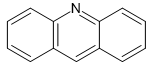
Figure . The molecular diagram of acridine.
| REFCODE | ACRDIN |
|---|---|
| Formula | C13 H9 N1 |
| Common Name | Acridine |
| IUPAC Systematic Name | Acridine |
| Other Names | Acridine |
| CSD Refcodes | ACRDIN04, ACRDIN07, ACRDIN08, ACRDIN02, ACRDIN05, ACRDIN06, ACRDIN12 |
| Scientist | Louise Price / Einat Schur (Rui Guo) |
| Date | 2010 |
| Publication | Schur, E.; Bernstein, J.; Price, L. S.; Guo, R.; Price, S. L.; Lapidus, S. H.; Stephens, P. W., Cryst. Growth Des. 2019, 9, (18), 4884-4893. DOI: Open paper (10.1021/acs.cgd.9b00557) |
| Search identifier | A |
| Energy model | 1 |
| Study_ID | 0 |
| Programs | MOLPAK, DMACRYS_2.0.4 (on CONDOR) |
| Location on S Drive | \\CHEMISTRY_CPOSS\\Acridine\\ACRDIN_CONDOR |
| Potential Description | MP2 6-31G(d,p) DMA +FIT |
| Search identifier | B |
| Energy model | 1 (published) |
| Study_ID | 20 |
| Programs | CrystalPredictor_v_unknown, DMACRYS_2.0.4 |
| Location on S Drive | \\CHEMISTRY_CPOSS\\Acridine\\ACRDIN_CP |
| Potential Description | CrystalPredictor + MP2 6-31G(d,p) DMA +FIT |
| Energy model | 2 |
| Study_ID | 21 |
| Programs | Study_ID=20, DMACRYS (2.3.1.1) |
| Location on S Drive | /CHEMISTRY_CPOSS/Acridine/ACRDIN_DFT |
| Potential Description | CrystalPredictor + MP2 6-31G(d,p) DMA +FIT |
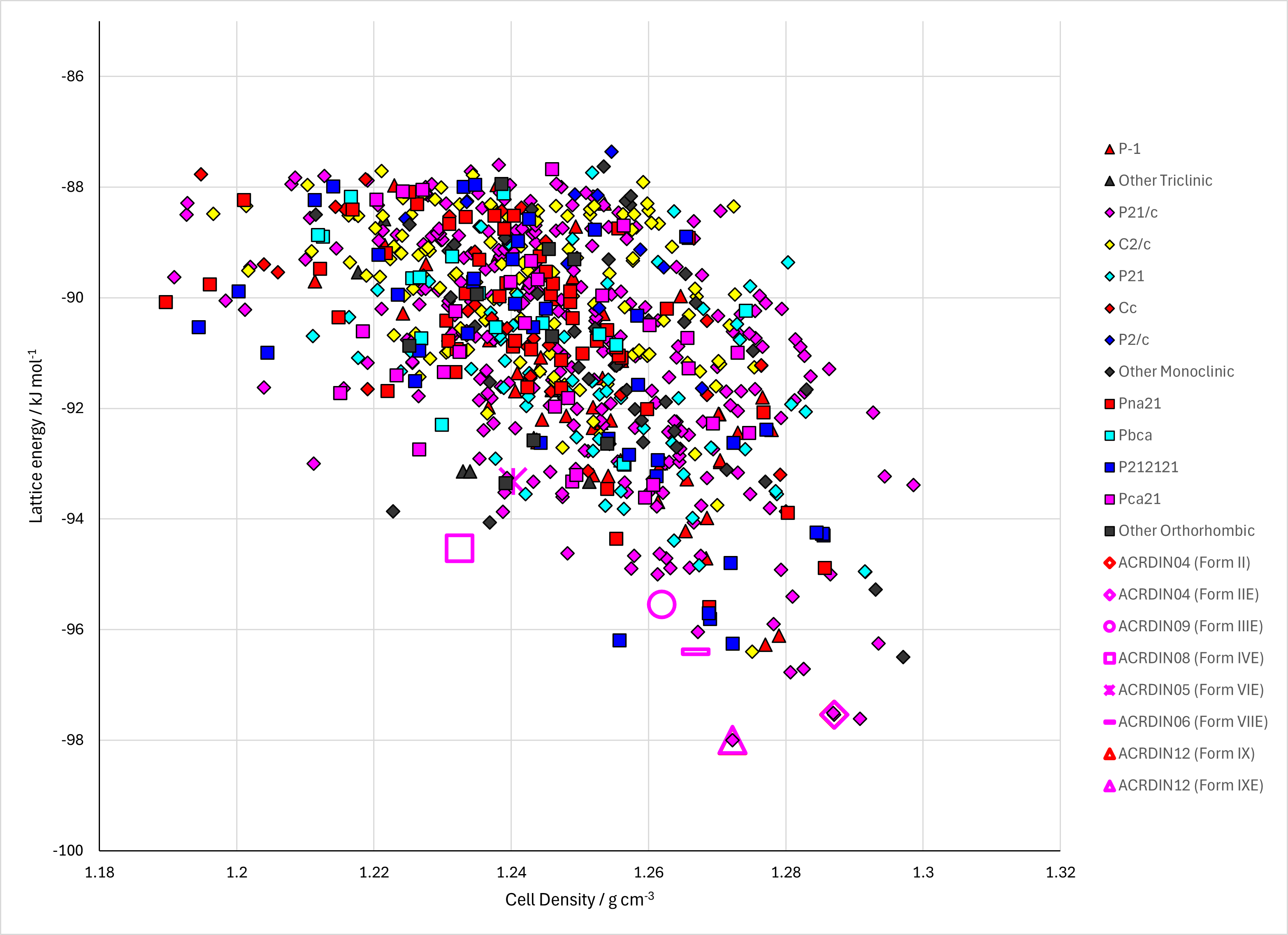
Figure . (Top) crystal energy landscape of Acridine from Study_ID=20. (Bottom left) crystal energy landscape of Acridine from Study_ID=0. (Bottom right) relative energies by method of key structures.
Although DFT+D energies for Study_ID=20 have been calculated, there are no molecular energies so the lattice energies are not included in the spreadsheet.
Table . Crystallographic information for CSD entries for Acridine. Different polymorphs are coloured differently.
| REFCODE | space group | Z’ | a / Å | b / Å | c / Å | α / ° | β / ° | γ / ° | density / g cm-3 | Form |
|---|---|---|---|---|---|---|---|---|---|---|
| ACRDIN | P21/a | 2 | 16.292 | 18.831 | 6.072 | 90 | 95.07 | 90 | 1.283 | III |
| ACRDIN01 | P21/n | 1 | 11.375(3) | 5.988(3) | 13.647(3) | 90 | 98.97 | 90 | 1.296 | II |
| ACRDIN02 | Aa | 2 | 20.040 | 5.950 | 16.370 | 90 | 110.63 | 90 | 1.303 | V |
| ACRDIN03 | P212121 | 3 | 15.610 | 29.340 | 6.220 | 90 | 90 | 90 | 1.254 | IV |
| ACRDIN04 | P21/n | 1 | 11.253(1) | 5.951(<1) | 13.602(1) | 90 | 99.53(<1) | 90 | 1.325 | II |
| ACRDIN05 | Cc | 2 | 6.174(2) | 23.497(8) | 12.868(4) | 90 | 96.48(<1) | 90 | 1.284 | VI |
| ACRDIN06 | P21/n | 2 | 6.057(1) | 22.813(4) | 13.204(2) | 90 | 95.94(<1) | 90 | 1.312 | VII |
| ACRDIN07 | P21/c | 2 | 6.069(<1) | 18.818(<1) | 16.283(<1) | 90 | 95.16(<1) | 90 | 1.285 | III |
| ACRDIN08 | P212121 | 3 | 6.179(<1) | 15.719(1) | 29.312(3) | 90 | 90 | 90 | 1.254 | IV |
| ACRDIN09 | P21/c | 2 | 3.047(7) | 18.800(20) | 16.200(19) | 90 | 95.23(1) | 90 | 1.327 | III |
| ACRDIN10 | P21/c | 2 | 6.028(7) | 18.760(20) | 16.171(19) | 90 | 95.18(1) | 90 | 1.372 | III |
| ACRDIN11 | P21/n | 1 | 11.183(5) | 5.934(1) | 13.590(4) | 90 | 99.84(4) | 90 | 1.34 | IX |
| ACRDIN12 | P21/n | 1 | 11.285(<1) | 12.382(<1) | 6.679(<1) | 90 | 92.06(<1) | 90 | 1.276 | IX |
| ACRDIN13 | P21/c | 2 | 6.070(<1) | 18.847(3) | 16.304(3) | 90 | 95.21(<1) | 90 | 1.282 | III |
The two polymorphs designated Form IX are definitely not the same polymorph.
Table . Experimental information for CSD entries for Acridine.
| REFCODE | space group | R factor | T / K | Year | Comments |
|---|---|---|---|---|---|
| ACRDIN | P21/a | 14.6 | RT | 1960 | Crystallization conditions not reported |
| ACRDIN01 | P21/n | 13.3 | RT | 1956 | Crystallization conditions not reported |
| ACRDIN02 | Aa | RT | 1955 | Crystallization conditions not reported | |
| ACRDIN03 | P212121 | RT | 1955 | Crystallization conditions not reported | |
| ACRDIN04 | P21/n | 3.81 | 185 | 2004 | Crystallization from DMF or 1:1 EtOH:MeOH mixture1 |
| ACRDIN05 | Cc | 4.03 | 187 | 2004 | Template-assisted crystallization1 |
| ACRDIN06 | P21/n | 5.73 | 185 | 2004 | Template-assisted crystallization1 |
| ACRDIN07 | P21/c | 4.72 | RT | 2010 | (Recrystallization from EtOH, ACN, THF, dioxane, toluene yields form II) Recrystallization from DCM or ethyeneglycoldimethyl ether2 |
| ACRDIN08 | P212121 | 5.24 | RT | 2010 | Recrystallization from DMSO2 |
| ACRDIN09 | P21/c | 3.63 | 173 | 2012 | Recrystallization from ethanol (not sure how to get it phase pure, or when it crystallizes concomitantly with II or IV)3 |
| ACRDIN10 | P21/c | 7.09 | 173 | 2012 | Recrystallization from ethanol (not sure how to get it phase pure, or when it crystallizes concomitantly with II or IV)3 |
| ACRDIN11 | P21/n | 20.58 | 100 | 2015 | Solvent-assisted grinding4 |
| ACRDIN12 | P21/n | 4.11 | RT | 2019 | Slow evaporation from toluene5 |
| ACRDIN13 | P21/c | 7.83 | RT | 2022 | Sublimation6 |
II, III, IV, IX all grown from solution. VI, VII grown by template assisted solvent crystallization.
The heat of fusion rule shows that II and III are enantiotropically related, and III and IX are enantiotropically related. However, we cannot conclude from experiment whether II or IX is the most stable low temperature form.7
1. X. F. Mei and C. Wolf, Crystal Growth & Design, 2004, 4, 1099-1103.
2. D. Braga, F. Grepioni, L. Maini, P. P. Mazzeo and K. Rubini, Thermochimica Acta, 2010, 507-508, 1-8.
3. A. Kupka, V. Vasylyeva, D. Hofmann, K. V. Yusenko and K. Merz, Crystal Growth & Design, 2012, 12, 5966-5971.
4. M. Lusi, I. J. Vitorica-Yrezabal and M. J. Zaworotko, Crystal Growth & Design, 2015, 15, 4098-4103.
5. P. W. Stephens, E. Schur, S. H. Lapidus and J. Bernstein, Acta Crystallographica Section E, 2019, 75, 489-491.
6. S. Wang, Y. Shen, X. Zhang, H. Liu, S.-T. Zhang, W. Li and B. Yang, Dyes and Pigments, 2022, 205, 110527.
7. E. Schur, J. Bernstein, L. S. Price, R. Guo, S. L. Price, S. H. Lapidus and P. W. Stephens, Crystal Growth & Design, 2019, 9, 4884-4893.