
Back to:
| Ordered alphabetically by REFCODE | Ordered alphabetically by Common name | Ordered by molecular formula | Grouped by family |
Pyridone
(Last updated June 2026)

Figure 1. The molecular diagram of Pyridone.
CSP studies
| REFCODE |
| ||
| Formula | C5 H5 N1 O1 | ||
| Common Name | 2-Pyridone | ||
| IUPAC Systematic Name | Pyridin-2(1H)-one | ||
| Other Names | |||
| CSD Refcodes | PYRIDO04, PYRIDO12 | ||
| Search Identifier |
| ||
| Scientist | Not sure | ||
| Date | 2012 | ||
| Publication | No publication planned. | ||
| Energy model |
| ||
| Study_ID | 0 | ||
| Programs | MOLPAK, DMACRYS (2.0.4) | ||
| Location on S Drive | \CHEMISTRY_CPOSS\Pyridone\FIT | ||
| Potential Description | DMA(PBE0/aug-cc-pVTz) + GDMA2 + FIT | ||
| Intramolecular Description | PBE0/aug-cc-pVTz | ||
| Search Identifier |
| ||
| Scientist | Not sure | ||
| Date | 2012 | ||
| Publication | No publication planned. | ||
| Energy model |
| ||
| Study_ID | 1 | ||
| Programs | MOLPAK, DMACRYS (2.0.4) | ||
| Location on S Drive | \CHEMISTRY_CPOSS\Pyridone\WILLIAMS | ||
| Potential Description | DMA(PBE0/aug-cc-pVTz) + GDMA2 + WILLIAMS | ||
| Intramolecular Description | PBE0/aug-cc-pVTz | ||
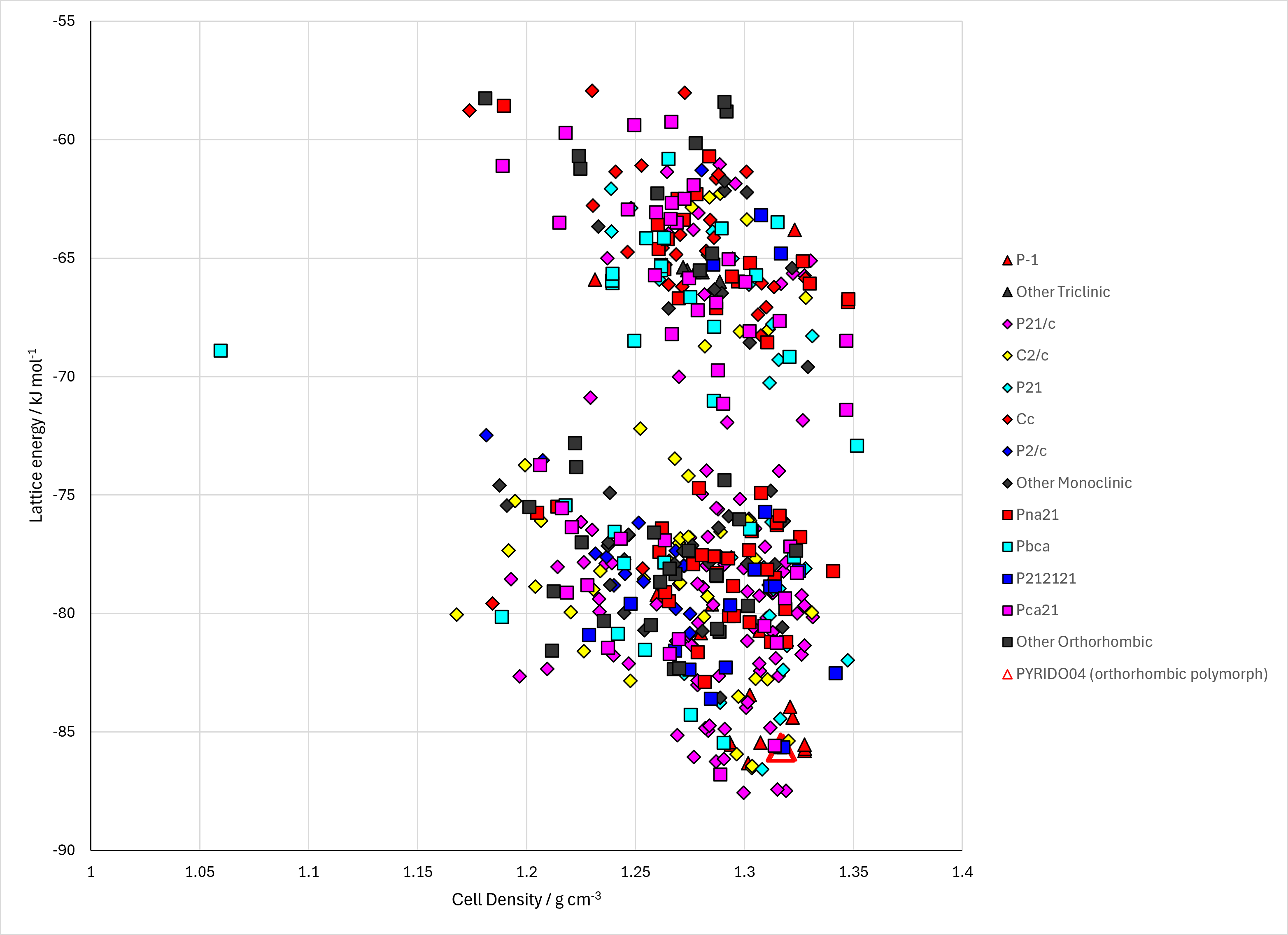
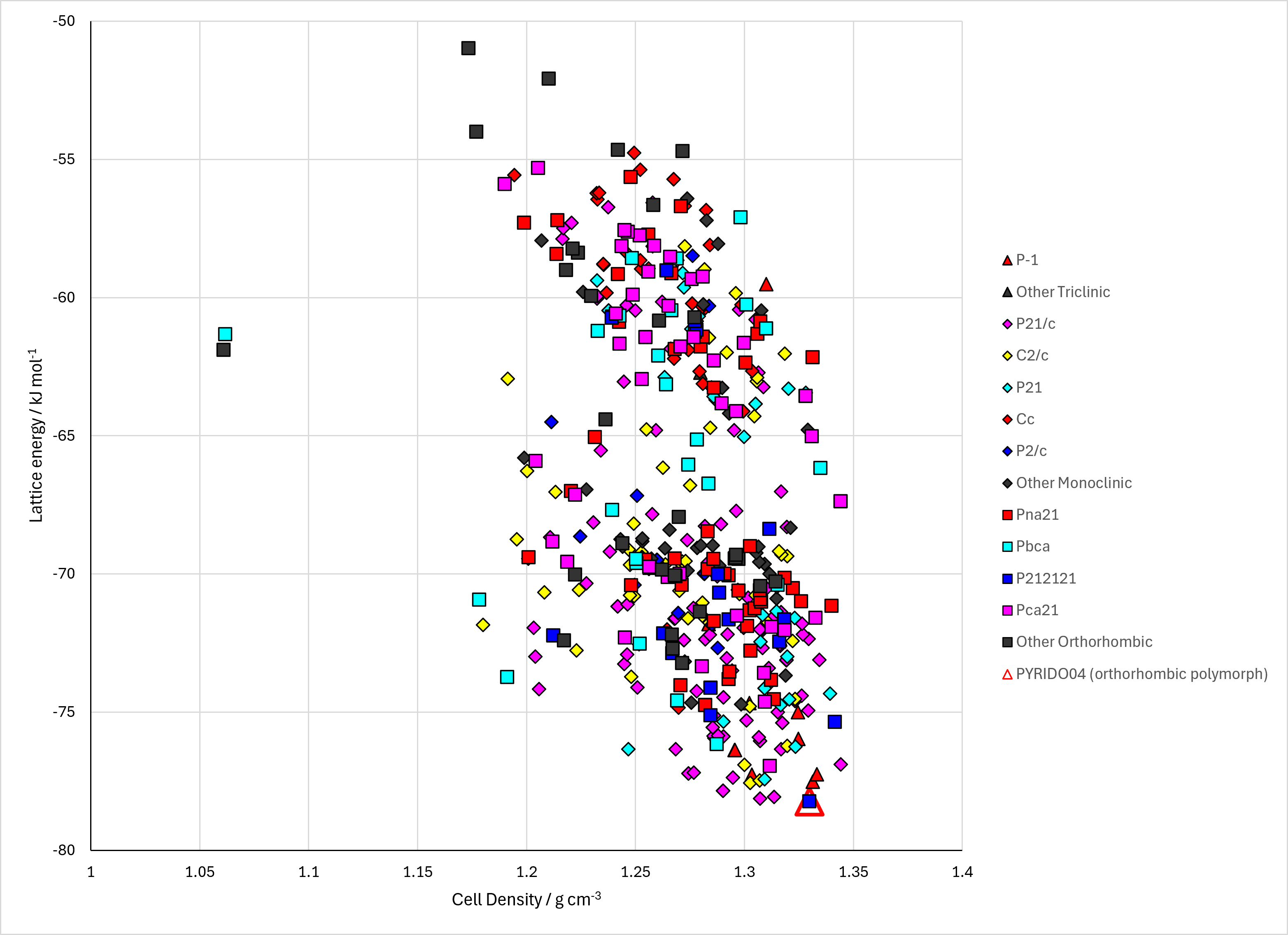
Figure 2. Lattice Energy Landscapes of Pyridone. Energy models A1 and B1.
CSD structures (CSD version 6.01 with Feb 2026 update)
Table 1. Crystallographic information and experimental information of CSD entries for Pyridone. Different polymorphs, as ascertained by structure matching of 20 molecule coordination sphere in Mercury, are coloured differently. Reference polymorphs are outlined in bold.
| REFCODE | Spacegroup | Z' | a / Å | b / Å | c / Å | α / ° | β / ° | γ / ° | density / g cm-3 | Form | R factor | T / K | Year | Comment / reference | REFCODE |
|---|---|---|---|---|---|---|---|---|---|---|---|---|---|---|---|
| PYRIDO | P212121 | 1.0 | 13.63 | 5.89 | 5.67 | 90.0 | 90.0 | 90.0 | 1.3876 | orthorhombic polymorph | 6.7 | None | 1953 | 10.1107/S0365110X5300168X | PYRIDO |
| PYRIDO02 | P212121 | 1.0 | 13.645 | 5.9 | 5.692 | 90.0 | 90.0 | 90.0 | 1.3784 | orthorhombic polymorph | 3.9 | None | 1984 | None | PYRIDO02 |
| PYRIDO03 | P212121 | 1.0 | 13.564 | 5.792 | 5.598 | 90.0 | 90.0 | 90.0 | 1.4362 | orthorhombic polymorph | 4.1 | at 120 K | 1984 | None | PYRIDO03 |
| PYRIDO04 | P212121 | 1.0 | 13.564 | 5.795 | 5.604 | 90.0 | 90.0 | 90.0 | 1.4339 | orthorhombic polymorph | 2.6 | at 120 K | 1984 | None | PYRIDO04 |
| PYRIDO05 | P212121 | 1.0 | 13.585 | 5.806 | 5.603 | 90.0 | 90.0 | 90.0 | 1.4293 | orthorhombic polymorph | 4.0 | at 123 K | 1998 | 10.1107/S0108768198006545 | PYRIDO05 |
| PYRIDO11 | P212121 | 1.0 | 13.657 | 5.912 | 5.70100 | 90.0 | 90.0 | 90.0 | 1.3722 | orthorhombic polymorph | 3.4 | None | 1984 | None | PYRIDO11 |
| PYRIDO12 | P21/n | 2.0 | 6.2027 | 16.327 | 9.1046 | 90.0 | 92.242 | 90.0 | 1.3711 | monoclinic polymorph | 4.4 | at 98 K | 2009 | 10.1107/S1600536809049496 | PYRIDO12 |
| PYRIDO13 | P212121 | 1.0 | 5.613 | 5.80840 | 13.5959 | 90.0 | 90.0 | 90.0 | 1.4250 | orthorhombic polymorph | 2.719 | 123 K | 2024 | 10.1002/chir.23617 | PYRIDO13 |
© UCL Chemistry Department 2022. This page was last updated on 30 Sep 2026. If you have any problems with this page please email the WebMaster